
Local: 801-537-3320 Toll Free: 888-UTAHMAP (882-4627)
Hours: Monday–Friday 9 a.m. to 5 p.m.
Closed for State of Utah holidays

-
-
- Recreation Books
- Adventure and Survival Books
- Hiking Books
- Outdoor Activities
- Fishing Maps & Books
- Rock Art and Scenic Books
- Nature Guide
-
Rockhounding, Geology and Mining
- Rockhounding, Geology and Mining
- Dinosaur and Fossil Books
- Geology Books
- Mineral Books
- Identification Field Guides
- Rockhounding Books
- Prospecting Books
- Mining Books
-
Navigation, First Aid and Knots
- Navigation, First Aid and Knots
- Knots Books
- First Aid Books
- Navigation Books
- Astronomy and Weather Books
-
- Geologic Publications
-
Economic Geology
- Economic Geology
- Engineering
- Minerals and Mining
- Uranium and Vanadium
- Coal Resources
- Fossil Energy
-
Minerals and Mining
- Minerals and Mining
- Gold
- Rocks, Minerals, and Fossils
- Mining
- Geologic Hazards
- Geothermal
- Great Salt Lake and Antelope Island
- Quaternary Studies and General Geology
- Paleontology and Paleoecology
- Stratigraphic Studies
- Water
- Public Interests
- Utah Geological Association
-
- Featured Maps and Books
- Exploring Southern Utah
- Utah Geological Survey - Survey Notes
-
- Deals
- Dino Deals
- Survival Books
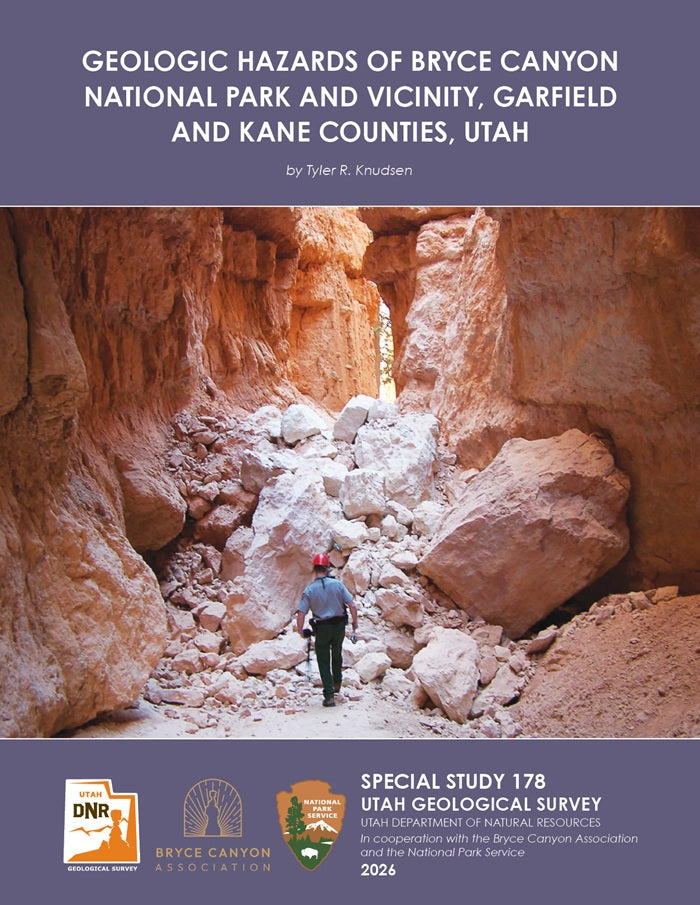
Geologic Hazards of Bryce Canyon National Park and Vicinity, Garfield and Kane Counties (SS-178)
SKU:
09972443
Availability:
Many In Stock
Product type:
Utah Geological Survey Special Studies
- $53.95
- $53.95
- Unit price
- / per
Subtotal:
$53.95
Description
xBy: Tyler R. Knudsen
The purpose of this study is to provide the National Park Service (NPS) and other land managers with geographic information system (GIS)-based information on the kind and location of geologic hazards that may affect existing and future development and visitor and employee safety in Bryce Canyon National Park and surrounding area. The Utah Geological Survey conducted a geologic-hazard investigation of a 265-square-mile (686 km2) area that encompasses Bryce Canyon National Park, the Town of Tropic, Bryce Canyon City, and recreational areas within the adjoining Dixie National Forest and Grand Staircase-Escalante National Monument. The study utilized all available geologic, hydrologic, soil, and geotechnical information to identify geologic hazards and where site-specific geotechnical/geologic-hazard investigations are necessary to protect health, welfare, and safety. Mapped hazards include rockfall, landslide, flooding/debris flow, shallow groundwater, surface faulting, liquefaction, collapsible soil, piping and erosion, wind-blown sand, soluble rock, corrosive soil and rock, expansive soil and rock, shallow bedrock, and radon.
Other Information:
Published: 2026
Pages: 45
Plates: 15
Location: Bryce, Utah
Media Type: Paper Publication
Related Products
Example product title
- $53.95
- $53.95
- Unit price
- / per
Example product title
- $53.95
- $53.95
- Unit price
- / per
Example product title
- $53.95
- $53.95
- Unit price
- / per
Example product title
- $53.95
- $53.95
- Unit price
- / per
Example product title
- $53.95
- $53.95
- Unit price
- / per
Example product title
- $53.95
- $53.95
- Unit price
- / per
Example product title
- $53.95
- $53.95
- Unit price
- / per
Example product title
- $53.95
- $53.95
- Unit price
- / per
Example product title
- $53.95
- $53.95
- Unit price
- / per
Example product title
- $53.95
- $53.95
- Unit price
- / per
Recently Viewed Products
Example product title
- $53.95
- $53.95
- Unit price
- / per
Example product title
- $53.95
- $53.95
- Unit price
- / per
Example product title
- $53.95
- $53.95
- Unit price
- / per
Example product title
- $53.95
- $53.95
- Unit price
- / per
Example product title
- $53.95
- $53.95
- Unit price
- / per
Example product title
- $53.95
- $53.95
- Unit price
- / per
Example product title
- $53.95
- $53.95
- Unit price
- / per
Example product title
- $53.95
- $53.95
- Unit price
- / per
Example product title
- $53.95
- $53.95
- Unit price
- / per
Example product title
- $53.95
- $53.95
- Unit price
- / per
- Choosing a selection results in a full page refresh.